
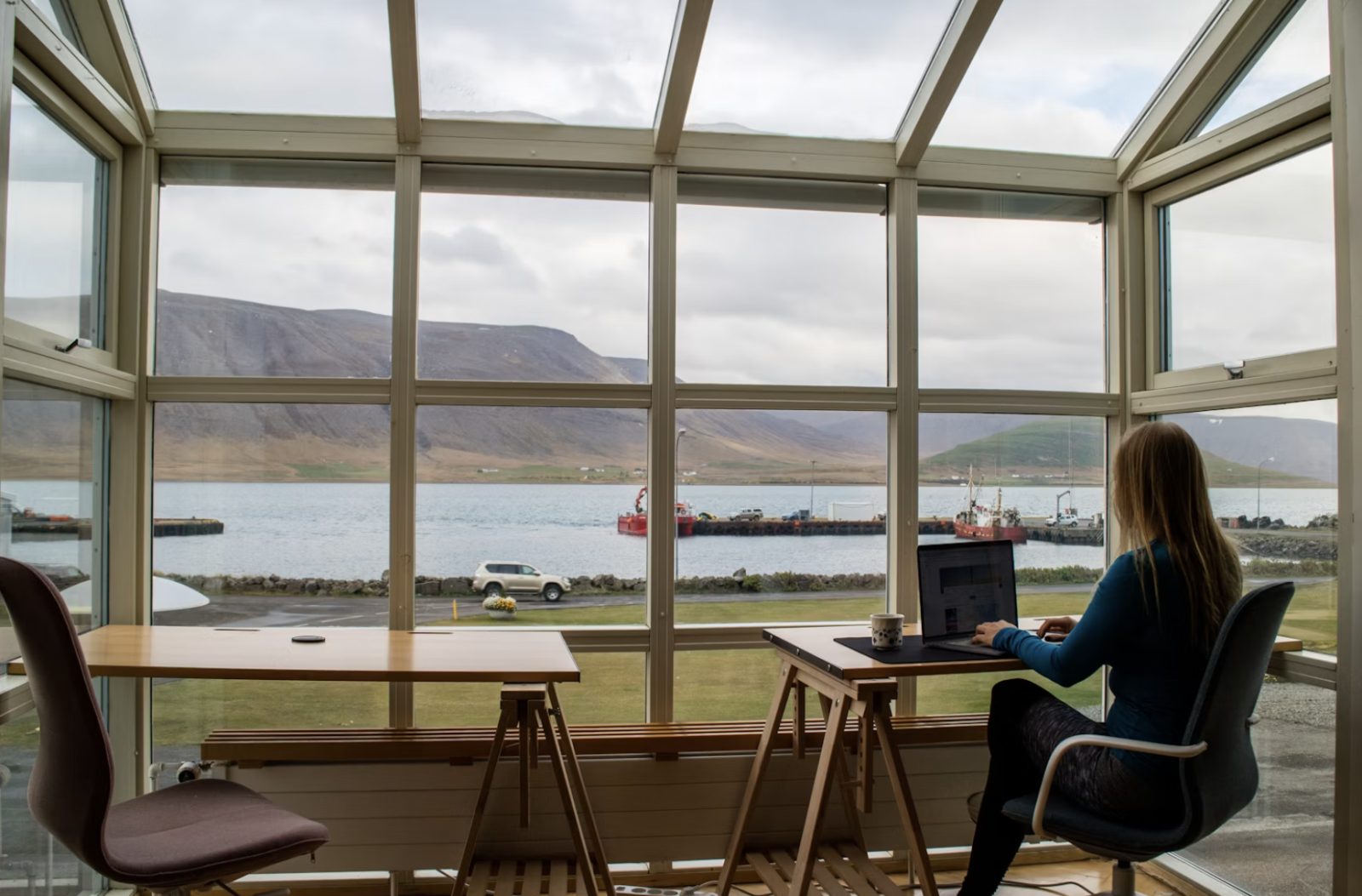
Remote work is often measured by productivity: tasks completed, hours worked, and response times. These measures show what gets done, but they do not show how the work gets done. For knowledge work, sustained attention, creative problem-solving, and good judgment also matter. The physical environment can affect each of these.
A dedicated workspace can create clearer boundaries between work and home. It can also reduce common distractions and provide a setting designed for focused work. This is one reason some remote workers choose coworking office Colorado instead of working from home or in public spaces.
The value of a professional workspace is not simply having a desk outside the home. It is having an environment that supports the type of work being performed. Quiet areas can support focused tasks, while shared spaces can make collaboration and professional interaction easier.
What Attention Research Shows About the Home Office Environment
Gloria Mark at the University of California Irvine has studied attention fragmentation in knowledge workers for more than two decades. Her 2023 research, summarized in her book Attention Span, found that the average duration of focused attention on a single screen in typical knowledge work conditions has declined from approximately 2.5 minutes in 2004 to approximately 47 seconds in 2020.
The home office environment contributes to this fragmentation through two mechanisms that office environments structurally reduce.
Environmental cue interference: Every room in a home contains objects and environmental cues associated with activities other than work. The kitchen signals hunger and food preparation. The couch signals rest. The children’s toys signal parental attention. These cues do not disappear because a laptop is open. They continue generating low-level attentional pulls that compete with the task requiring focused attention. The workspace that is physically distinct from living space does not carry these cues.
Self-interruption rate: Mark’s research found that approximately 44 percent of attention interruptions in home office settings were self-initiated, the worker broke their own attention rather than being interrupted by an external event. In dedicated office environments, self-interruption rate dropped to approximately 29 percent of total interruptions. The physical environment of a professional workspace contains fewer self-interruption triggers.
The recovery time from each interruption is where the cumulative cost accumulates. Mark’s research documents that returning to the same level of cognitive engagement on a complex task after an interruption takes an average of 23 minutes. Six self-initiated interruptions in a morning represent not six minutes of lost time but potentially 138 minutes of reduced cognitive engagement quality, regardless of whether the worker appears to be working.
What Neuroscience Shows About Place-Based Cognitive States
The prefrontal cortex, which governs executive function including sustained attention, working memory, and decision-making, requires periods of transient hypofrontality, temporary reduction in prefrontal activity, to maintain its capacity over time. This recovery happens most reliably in environments that the nervous system associates with non-work activity through consistent context.
A worker who eats, sleeps, exercises, and works in the same physical space provides their nervous system with inconsistent context signals for prefrontal engagement state. The nervous system does not receive a reliable cue that work has ended and recovery has begun. The result, documented across multiple studies of work-life boundary and recovery research, is reduced recovery quality and elevated baseline cortisol in workers with poor work-home spatial separation.
The act of leaving a dedicated workspace and returning to a distinct residential environment is not merely a psychological ritual. It is a physical context change that provides the nervous system with a transition cue that the brain uses to shift prefrontal engagement state. Home offices cannot replicate this cue because the transition does not change the physical environment.
A meta-analysis in the Journal of Vocational Behavior reviewing 23 studies of boundary management and recovery from work found that workers with clear spatial separation between work and home domains reported 34 percent lower cognitive spillover of work-related thoughts into leisure time than workers without clear spatial separation.
What Network Science Shows About Serendipitous Professional Contact
MIT’s Human Dynamics Laboratory has produced research on the relationship between physical co-location and professional network formation that has significant implications for remote work decisions. Alex Pentland’s research using sociometric badges measured actual interaction patterns in organizations and found that face-to-face interaction is roughly 40 times more effective than digital interaction at producing the kind of brief, unscheduled contact that leads to new professional connections and cross-domain idea transfer.
The mechanism is serendipity. A brief hallway conversation, an overheard comment that connects to a problem you are working on, a visual signal from a colleague’s desk that creates an occasion for an unscheduled discussion, none of these occur in a digital work environment regardless of how many video calls are scheduled.
For freelancers, consultants, early-stage entrepreneurs, and remote workers building professional networks, the mathematical probability of serendipitous contact is close to zero at a home office and non-trivial at a shared workspace where members represent multiple industries, functions, and professional stages.
The network effects of co-working compound over time in a way that individual productivity measures do not capture. The connection made in month one of a co-working membership produces a referral, a collaboration, or a professional opportunity in month fourteen. None of this appears in a productivity metric.
What the Total Cost of Working From Home Actually Includes
The home office decision is typically framed as: co-working costs money, home office is already paid for. This framing excludes four cost categories that make the comparison inaccurate.
Electrical cost: A computer, dual monitors, printer, and desk lamp running eight hours per day at residential electricity rates adds approximately $25 to $45 per month to the home electrical bill beyond the baseline.
Broadband upgrade cost: Reliable symmetrical upload speed for video conferencing requires business-grade broadband in most residential markets. Upgrading from standard residential to business-grade adds $30 to $60 per month in most Colorado markets.
Dedicated space cost: The square footage occupied by a home office is not free. At Denver metro’s average residential rental rate of approximately $1.85 per square foot per month, a 10 × 12-foot home office represents $222 per month in space cost that the residential lease or mortgage payment carries.
Tax treatment: Business use of home office space qualifies for IRS Form 8829 deduction, which partially offsets the space cost but requires the space to be used exclusively and regularly for business, a threshold that shared residential space does not meet.
At $750 per month for a co-working hot desk membership, the comparison against home office is not $750 versus $0. It is $750 versus approximately $277 to $327 per month in actual home office costs, a net premium of $423 to $473 per month for a dedicated professional environment with consistent internet, professional meeting space, and the cognitive architecture benefits documented above.
Key Takeaways
- Gloria Mark’s research found self-interruption accounts for approximately 44 percent of attention interruptions in home offices versus 29 percent in dedicated office environments
- Recovery to full cognitive engagement on a complex task after interruption takes an average of 23 minutes, making interruption frequency the primary determinant of effective cognitive work time
- A 2021 Journal of Vocational Behavior meta-analysis found workers with clear spatial work-home separation reported 34 percent lower cognitive spillover into leisure time
- MIT Human Dynamics Laboratory research found face-to-face interaction is approximately 40 times more effective than digital interaction for serendipitous professional network contact
- The true cost of a home office (electrical, broadband upgrade, space cost) runs $277 to $327 per month, narrowing the effective premium for co-working to $423 to $473 per month compared to the apparent $750 versus $0 framing
The question is not whether remote work is possible. It clearly is. The question is whether the physical environment of the home office delivers the cognitive conditions that the work requires. The research that answers that question has been consistent across two decades of study.