
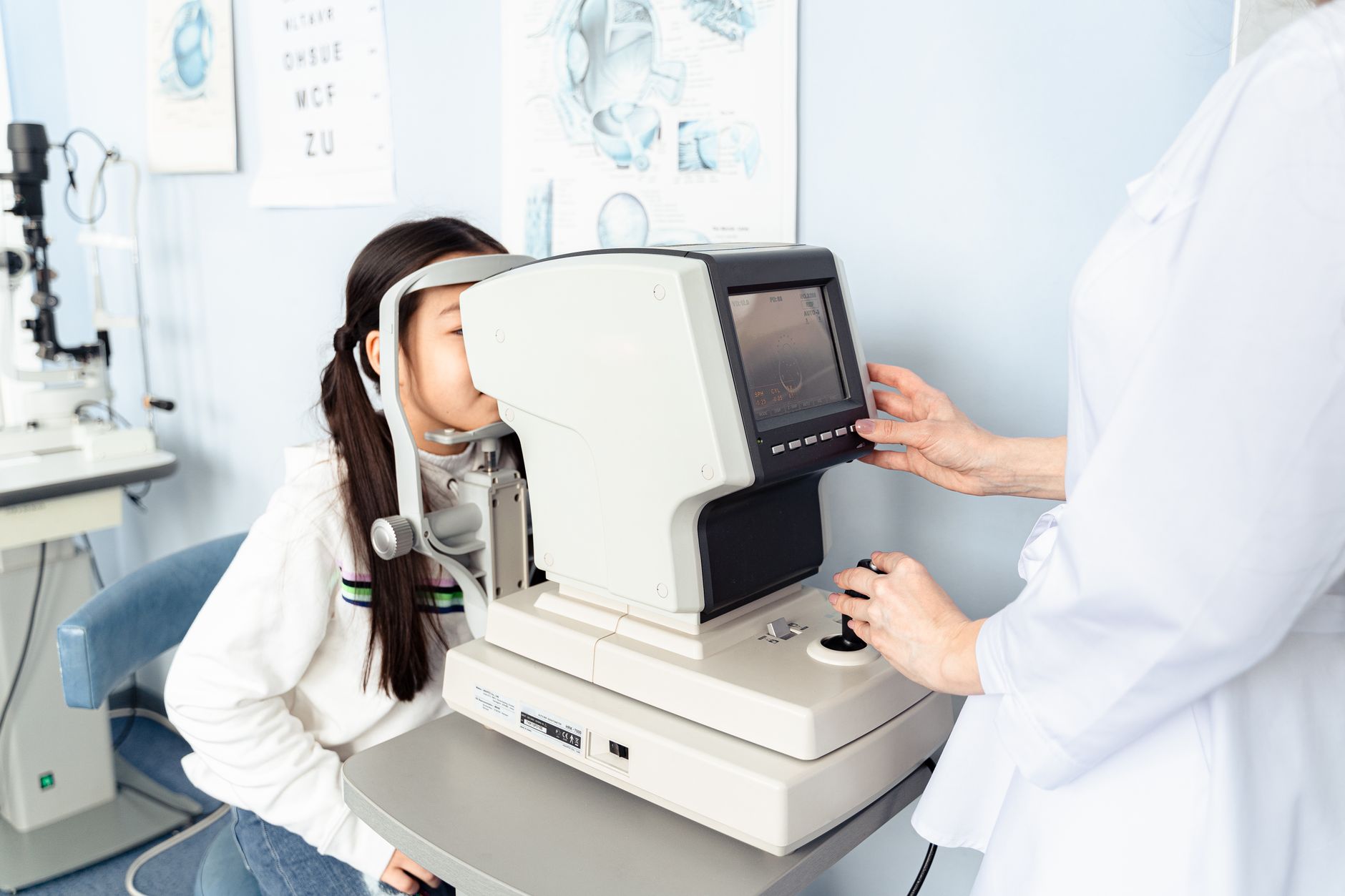
The connection between vision and learning is direct and significant. The majority of information processed in a typical school day arrives through the visual system, and vision problems that are undetected create a learning environment where the child is working significantly harder than peers with normal vision. These seven ways a comprehensive eye exam catches problems before they affect learning explain why annual exams are worth prioritizing.
1. Detecting Nearsightedness Before It Affects Classroom Learning
Myopia, or nearsightedness, allows clear near vision but blurred distant vision. In a classroom setting, a nearsighted child who is not corrected cannot read from the board, see projected content clearly, or follow visual demonstrations that depend on seeing at distance. Because children adapt rather than complaining, a nearsighted child may stop looking at the board entirely and copy from the person next to them, losing the direct educational input that classroom instruction provides.
2. Identifying Farsightedness That Makes Reading Uncomfortable
Farsightedness, or hyperopia, often produces clear distance vision but requires extra accommodative effort for close work. In young children with mild to moderate hyperopia, the accommodation is managed successfully but at a cost of significant eye strain and fatigue. Reading and close work become physically uncomfortable enough that children avoid sustained reading, which affects both skill development and academic engagement.
3. Catching Convergence Insufficiency That Disrupts Reading
Convergence insufficiency is a binocular vision disorder where the eyes have difficulty working together for sustained near focus. It causes words to appear to move, double briefly, or blur on the page during reading, which makes sustained reading physically difficult and unpleasant. It is a significant cause of reading avoidance in children and is frequently misidentified as a reading disability or attention problem.
4. Screening for Amblyopia During the Treatment Window
Amblyopia detected during the developmental period when the visual system is still forming can be effectively treated with patching, atropine drops, and in some cases vision therapy. The same condition detected after the developmental window has closed responds significantly less well to treatment. Annual exams during the developmental years create the opportunity to catch amblyopia while it is most treatable.
5. How Much Does an Eye Exam Cost Without Insurance?
The cost of a comprehensive eye exam for children without insurance coverage varies by provider, geographic location, and whether additional testing is needed. Pearle Vision’s eye exam for kids pricing is available at each location, and the team can provide a cost estimate before the appointment for families without coverage.
Nationally, the cost of a comprehensive eye exam without insurance typically ranges from $100 to $200 depending on the provider and location. Several programs exist to reduce this cost for eligible families, including the Lion’s Club’s sight programs, EyeCare America, and state-specific assistance programs for children. Many states also cover pediatric vision services through Medicaid.
6. Identifying Color Vision Deficiency That Affects Learning Materials
Color vision deficiency, commonly called color blindness, affects approximately eight percent of boys and half a percent of girls. In a classroom environment that uses color-coded learning materials, maps, charts, and diagrams, color vision deficiency creates a consistent gap between what a color-sighted child and a color-deficient child can access.
Identifying color vision deficiency allows teachers to be informed about the accommodation needed and allows parents to ensure educational materials are accessible in formats that do not rely on color differentiation.
7. Establishing a Baseline for Monitoring Change Over Time
The most significant value of annual eye exams during childhood is not just what is detected in any single exam but the trend data that accumulates across exams. A prescription that is stable over two years is reassuring. One that is increasing consistently by half a diopter per year indicates myopia progression that warrants proactive management to slow the progression rate and reduce the risk of higher prescription levels and associated eye health risks in adulthood.