
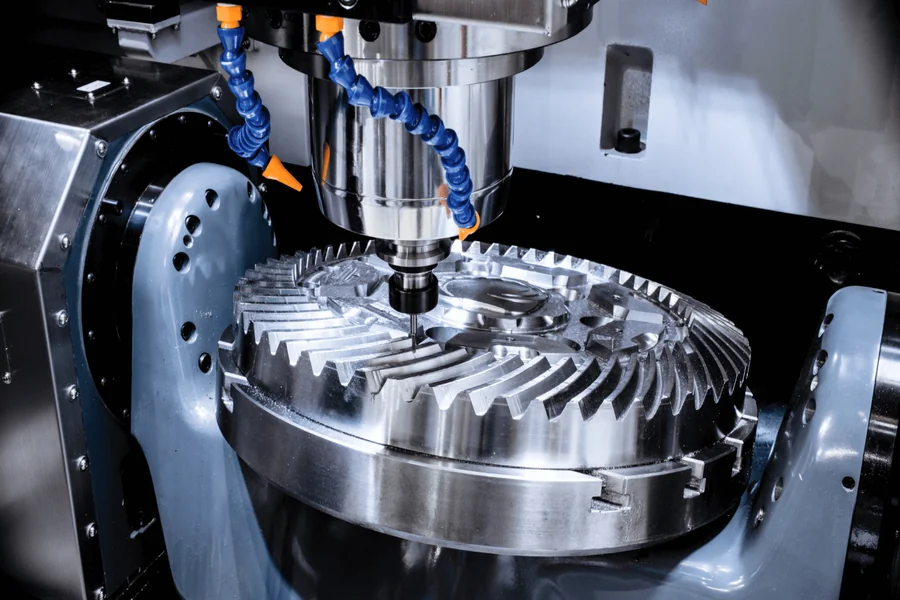
In a production environment that depends on precision machining, a milling machine is not just equipment — it is a core contributor to workflow stability, product quality, and delivery consistency. Milling machines perform complex material removal tasks on metals, composites, and engineered plastics. Their performance directly affects scrap rates, cycle times, and downstream operations like heat treatment and assembly.
Machines do not remain in their optimal state indefinitely. Mechanical wear, control drift, lubrication breakdown, and environmental conditions gradually change how a milling machine behaves. These changes, while often subtle at first, can lead to dimensional inaccuracies, poorer surface finishes, and unplanned downtime if left unaddressed. A clear understanding of how and when to service these assets is essential for maintenance planners, operations managers, and business owners who must balance productivity with cost and reliability.
The following guide provides a grounded framework for understanding the essentials of milling machine service — from what it involves to how it supports operational resilience.
What Milling Machine Service Entails
Professional Milling Machine Service guide brings together mechanical inspection, alignment verification, control assessment, and performance validation. It is not simply a clean‑and‑check routine; it is a systematic evaluation that ensures a milling machine continues to meet its design performance criteria.
At its core, milling machine service includes:
- Mechanical evaluation: checking the condition and alignment of guides, spindles, drive systems, bearings, and structural frames.
- Control system diagnostics: reviewing how the machine interprets and executes commands, examining feedback loops, and identifying control board or input/output issues.
- Lubrication system inspection: verifying that lubrication delivery meets manufacturer recommendations and that lubricant quality has not degraded.
- Thermal and vibration analysis: identifying heat accumulation or vibration patterns that suggest deeper mechanical or control issues.
The goal is to restore or verify the machine’s ability to cut within tolerance, maintain surface quality, and operate reliably under typical production loads.
Why Regular Service Matters in Operations
Milling machines are not static devices. Components shift, wear, and respond to environmental stress. Unlike cosmetic issues, these changes often affect functional performance first and become visible only when they cross certain thresholds. A comprehensive machine tool reference notes that deviations in structure and motion directly influence machining accuracy and repeatability.
Maintaining performance matters because:
- Dimensional control affects downstream processes: Parts produced outside tolerance can disrupt assembly lines, increase inspection load, and trigger rework.
- Repeatability impacts throughput: Inconsistent responses from a machine slow cycle times and make planning less predictable.
- Component longevity influences budget: Neglected wear often accelerates failure in related subsystems, increasing repair costs.
- Reliability builds confidence: Production schedulers depend on machines that behave predictably from shift to shift.
Viewed this way, servicing isn’t a discretionary activity — it is part of managing the lifecycle of a production asset.
When Businesses Should Schedule Service
Rather than waiting for visible failures, businesses benefit from a planned approach that aligns with production rhythms and usage intensity. The following markers are practical triggers for professional service:
- Scheduled intervals based on operating hours: Machines in multi‑shift environments accumulate wear faster than those used intermittently.
- After a major job where cuts were heavy or prolonged: Higher forces and temperatures accelerate component wear.
- When deviations in finished part quality are detected: Dimensional drift or surface irregularities can be a symptom of internal changes.
- Following control system faults that recur: Persistent alarms or irregular response behavior suggest deeper issues.
- If vibration or noise patterns differ from historical norms: Sustained changes in sound or feel can signal mechanical issues.
Service planning should incorporate both calendar intervals and condition‑based triggers. Internal maintenance teams are often the first to notice early signs, but professional technicians bring tools and methods that reveal issues beyond everyday observation.
Core Elements of Milling Machine Service
Service is a multi‑phase process that addresses both symptoms and root causes. A thorough job typically includes the following stages:
Mechanical and Structural Inspection
This phase verifies that the physical backbone of the machine remains within acceptable limits. It involves:
- Guideway and way surface checks: Wear patterns, debris accumulation, and clearance changes are measured.
- Spindle condition assessment: Runout and balance are evaluated, often with dial indicators or laser systems.
- Backlash measurement: Excessive play in ball screws or gears is identified and corrected.
- Frame and base integrity assessment: Warps or loosened structural components are examined.
Mechanical issues are often at the heart of machining inconsistencies. Detecting and correcting them restores the foundation for accurate motion.
Control System Diagnostics
Modern mills integrate complex electronic controls, including programmable logic controllers (PLCs) and numeric control units. This work includes:
- Feedback loop analysis: Encoders, resolvers, and sensors are tested to confirm accurate positional feedback.
- I/O channel checks: Inputs from buttons, switches, and safety interlocks are verified for consistency.
- Software response evaluation: The control’s interpretation of programmed commands is assessed under test cuts.
Control issues can masquerade as mechanical problems if not properly isolated. Diagnostics ensure that the machine’s “brain” is not miscommunicating with its mechanical systems.
Lubrication and Cooling System Evaluation
Lubrication is essential for reducing friction, preventing wear, and maintaining component life. This step checks:
- Lubricant quality: Viscosity, contamination, and depletion are measured.
- Delivery integrity: Pumps, lines, and distribution nodes are tested for flow and pressure.
- Cooling performance: Coolant delivery to critical zones is confirmed to manage heat effects.
Inadequate lubrication and cooling affect both tool life and machine health.
Thermal and Vibration Assessment
Heat affects clearances and dimensions, while vibration can introduce natural frequency issues that compromise surface finish. Evaluations include:
- Infrared and temperature profiling: Hot spots are identified in motors, spindles, and electrical cabinets.
- Vibration mapping: Accelerometers or vibration sensors detect patterns that indicate imbalance or looseness.
Thermal and vibration behavior under load offers insight into conditions that static checks cannot reveal.
How Professional Service Supports Business Goals
Engaging professional milling machine service delivers several operational advantages that contribute directly to business outcomes:
- Fewer unplanned stoppages: Early detection of issues reduces the likelihood of abrupt breakdowns.
- Higher part quality consistency: With verified machine geometry and control behavior, dimensional consistency improves.
- Longer tooling life: A stable machine subject to fewer irregular forces extends the life of cutting tools.
- More predictable maintenance budgets: Planning service visits allows for budget allocation rather than emergency spend.
These benefits matter in facilities where throughput, quality, and cost control are part of performance metrics.
What Businesses Should Expect from a Service Provider
Not all maintenance providers offer the same depth of service. When selecting a partner, consider whether the technician:
- Uses specialized diagnostic tools (e.g., laser alignment, thermal imaging, vibration analysis).
- Provides documented reports with findings, corrective actions, and future recommendations.
- Demonstrates familiarity with your machine’s specific make and model.
- Coordinates service timing with production schedules to minimize disruption.
An effective partner approaches maintenance systematically rather than through ad‑hoc fixes.
How Internal Teams and Professional Service Work Together
Internal maintenance crews play a valuable role in daily checks — topping up lubricants, clearing chips, tightening loose guards, and addressing obvious faults. These front‑line activities contribute to machine health awareness.
Professional service complements this work by:
- Handling deeper diagnostics and adjustments beyond routine checks.
- Bringing measurement tools not typically available in a maintenance shop.
- Confirming that internal observations align with deeper system conditions.
This collaboration — routine internal care plus periodic professional verification — forms a balanced strategy that supports reliability without overburdening internal resources.
Planning Service Visits without Disrupting Production
A common concern is that service visits interrupt workflow. Good planning reduces this impact:
- Schedule service during planned breaks, shift turnovers, or lighter production windows.
- Provide technicians with historical logs or operator notes ahead of the visit.
- Prioritize tasks by criticality so that high‑impact checks occur first.
Service does not have to mean downtime; it can become part of the rhythm of proactive upkeep.
Keeping Records and Using Data for Better Decisions
Documentation generated from service visits is not paperwork — it is operational data. Use it to:
- Track wear patterns and identify recurring issues.
- Predict when specific components may require attention next.
- Compare historical performance data with observed conditions.
- Justify budgeting decisions with evidence rather than opinion.
Data‑driven maintenance planning enhances both technical and financial decision‑making.
Conclusion
Milling machines are complex systems where mechanical, electrical, and control elements interact under the constant influence of production demands. Maintaining performance requires more than occasional cleaning or reactive fixes. A comprehensive Milling Machine Service guide helps businesses understand the processes that keep these machines stable, accurate, and reliable over time.
Regular professional service — coordinated with internal maintenance efforts and production planning — supports:
- Better quality outcomes.
- Predictable uptime.
- Lower lifecycle costs.
- Informed decision‑making.
When service becomes part of the operational discipline rather than an afterthought, milling machines remain assets that contribute to predictable throughput and consistent product standards. Understanding and implementing effective service practices is a practical step toward maintaining competitive performance in today’s manufacturing environment.