
An Ancient Survival Instinct
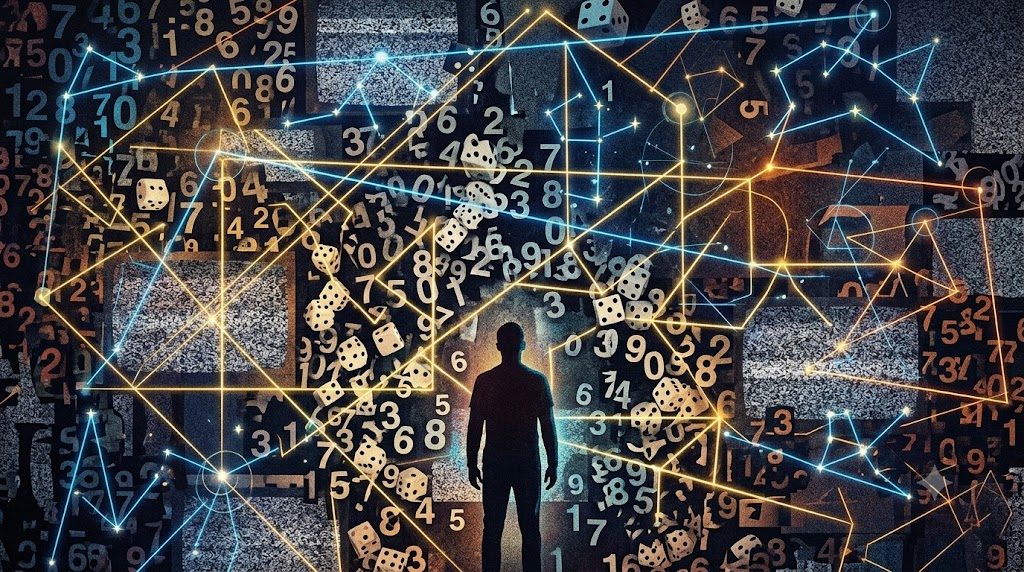
The human brain is built to err on the side of caution. In ancestral environments, missing a threat was often fatal. If a shadow moved in the tall grass, the safest assumption was a predator, and everyone ran. Most of the time it was just the wind. Psychologists call that kind of mistake a false positive, or Type I error. Running from a harmless breeze cost a few calories, while failing to spot a real threat could cost your life. Over time, natural selection favored brains that find meaning in noise.
Dopamine plays a big part in this. It rewards us when we predict something correctly, which reinforces our pattern-finding habits. We also hate feeling helpless, and when a situation takes away our sense of control, that instinct goes into overdrive. Jennifer Whitson and Adam Galinsky showed this in a well-known 2008 set of studies published in Science. Participants who were made to feel a lack of control were more likely to see images in random visual noise, perceive conspiracies and form superstitions. Unpredictability is deeply uncomfortable, so the mind calms itself by building a story and laying it over the chaos.
The Cost of Picking Your Own Lottery Numbers
Casino games show how much this instinct can cost. Human thinking runs on two systems: a fast, emotional autopilot and a slower, analytical mode that can actually grasp statistical independence. The analytical mode takes effort, so we tend to rely on the autopilot, and the autopilot is bad at probability. Harvard psychologist Ellen Langer identified this flaw in the 1970s and named it the illusion of control. People overestimate their influence over pure chance when a situation includes "skill cues" such as competition, physical involvement or a simple choice. Add any of those, and the mind starts treating a random event as a game of skill.
Langer's office lottery study is the classic example. Half the participants were handed a random ticket, and the other half chose their own. Every ticket had exactly the same tiny chance of winning. Yet when the researchers later offered to buy the tickets back, people who had been handed a ticket asked for an average of $1.96, while those who had chosen their own asked for $8.67. Simply making a choice raised the ticket's perceived value by more than four times. The same instinct shows up when craps players throw the dice gently to try to roll low numbers, as if they could control the physics of a bouncing die.
The Gambler's Fallacy at Work
This blind spot catches professionals too, because many people misunderstand independent probability. The Gambler's Fallacy is the belief that after five heads in a row on a fair coin, tails is "due." The coin has no memory. The chance of tails on the sixth toss is still exactly fifty percent.
A sixteen-sided die makes the point clearly. Say you get sixteen rolls to roll a one, and each roll has a 6.25 percent chance of success. After five misses, it's tempting to think a win is imminent. In fact, you've just used up five of your chances. Your odds of rolling at least one win in the remaining eleven rolls are now about fifty percent, lower than when you started, and the chance on each remaining roll is still 6.25 percent. The die doesn't care about your losing streak.
This refusal to accept randomness also affects serious professional decisions. In a 2016 study, economists Daniel Chen, Tobias Moskowitz and Kelly Shue analyzed decisions by asylum judges, loan officers and Major League Baseball umpires. Asylum judges were 3.3 percentage points less likely to grant asylum if they had approved the previous case, and 5.5 percentage points less likely after two approvals in a row. Umpires were less likely to call a borderline pitch a strike if the previous pitch had been a strike. These experts were unconsciously reversing their decisions to make their record look balanced. That means a qualified asylum seeker could be turned down partly because the person before them was approved.
Blind Spots on the Trading Floor
On trading floors, this ancient instinct becomes a real financial liability. Trading is high-pressure and noisy, which is exactly the kind of setting that triggers mental shortcuts. Some analysts make a fortune trading biotech stocks, but over a three-month stretch it's very hard to tell skill from luck. Casino games are the clearest example of the opposite: at licensed online casinos, every spin of a roulette wheel or hand of blackjack is independent of the last, so any pattern a player sees is in their head.
In a 2003 study, Mark Fenton-O'Creevy and colleagues tested 107 professional traders at London investment banks with a computer task in which the price movements were random, no matter which keys the traders pressed. The traders who showed the strongest illusion of control, believing their inputs were moving the market, turned out to be the weaker performers in their real jobs. They earned less, contributed less to their firm's profits and were worse at managing risk. Their sense of control was inversely related to how well they actually did. The same psychology shows up in consumer technology today. Designers sometimes add cosmetic "skill cues" to chance-based features, such as a button that lets players stop a slot machine reel by hand, which creates a false sense of control without changing the outcome.
The Uncomfortable Math of Reality
The fix takes discipline, not just good intentions. It means deliberately switching on the slower, analytical side of your thinking. When you suddenly feel certain that a market is about to turn, it helps to recognize that feeling for what it often is: your brain's pattern-finding instinct firing on random data. Professionals do better when they anchor their decisions to objective base rates instead of gut feeling.
Our ancestors survived by connecting the dots in the tall grass. Today, it pays to recognize that most of those dots are just noise. Accepting how little control we have over randomness frees up our money and attention for the few things we can actually influence.