
When a procurement team selects a supplier for complex molded components, the decision carries weight well beyond price and lead time. For parts that require two materials, two colors, or two distinct functional layers bonded into a single unit, the supplier’s process capability becomes the central variable. A poor fit between the manufacturer’s actual equipment, tooling experience, and quality systems can result in delamination, dimensional inconsistency, or yield problems that take months to surface—and longer to resolve.
Two-shot injection molding is a process that demands more from a supplier than standard single-material molding. The machinery is more complex, the tooling design requires tighter coordination, and the material compatibility decisions made early in development affect everything downstream. For procurement teams evaluating vendors—whether for the first time or reconsidering an existing relationship—having a structured, objective framework reduces the risk of selecting based on surface-level criteria alone.
This guide outlines the key evaluation categories procurement teams should work through when assessing candidates, what to look for inside each one, and why certain indicators matter more than others in production environments.
Understanding What You Are Actually Sourcing
Two-shot injection molding is a manufacturing process in which two different materials are injected into a mold sequentially or simultaneously, producing a single integrated component without assembly. The bond between the two materials is either mechanical, chemical, or both, depending on the material pairing and tooling design. This is meaningfully different from overmolding, insert molding, or post-production bonding—and the distinction matters when evaluating suppliers.
When procurement teams search for 2-shot injection molding companies, they are often comparing suppliers who present similar capabilities on paper. The practical difference between a supplier who runs this process routinely and one who runs it occasionally can be difficult to detect from a capabilities sheet alone. Industry guidance on plastics manufacturing processes—including those outlined by organizations like the Society of Plastics Engineers—makes clear that process consistency in two-shot molding depends on equipment integration, tooling precision, and materials science in combination, not in isolation.
Before applying any evaluation criteria, procurement teams should confirm they are comparing suppliers who operate the same category of process. A supplier who achieves a similar visual result through secondary operations is not a two-shot molder, regardless of how their quoting language describes it.
Why the Distinction Between Process Types Matters for Long-Term Supply
A supplier who achieves a two-material part through sequential processes carries a fundamentally different risk profile than one using a true two-shot machine. Secondary bonding, adhesive joining, or manual assembly introduces additional points of failure—especially in applications where thermal cycling, mechanical stress, or chemical exposure are part of the use environment.
When this distinction is not clarified early, procurement teams may find themselves locked into a supply arrangement where the process cannot scale efficiently, cannot meet certain tolerance requirements, or cannot maintain consistency across production runs. This usually becomes visible only after tooling investment has been made.
Equipment and Tooling Infrastructure
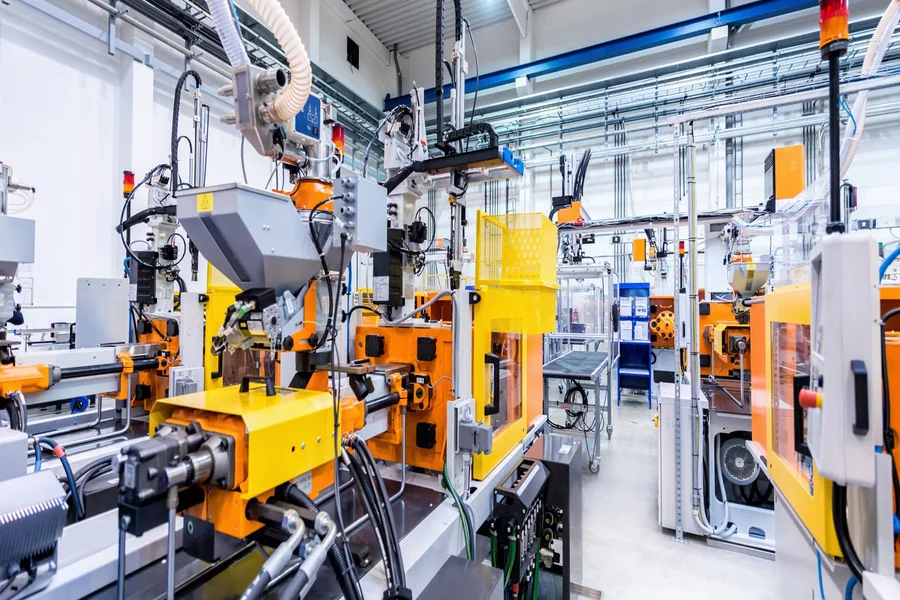
The physical infrastructure of a two-shot molder directly determines what they can produce and at what level of repeatability. Two-shot machines differ from standard injection presses in that they require coordinated injection units, rotating or indexing mold systems, and precise thermal control across both material channels. The tooling designed for this process must account for the movement of the substrate between shots, the shrinkage behavior of each material, and the registration required to hold the second shot in position relative to the first.
A supplier’s equipment list tells part of the story, but the configuration of that equipment tells more. A machine with the correct clamping force but poorly maintained thermal controllers or inconsistent injection timing will produce parts that vary from cavity to cavity. During any site evaluation or technical review, procurement teams should ask about equipment age, maintenance schedules, and how tooling is qualified before production begins.
Tooling Ownership and In-House Design Capability
Tooling for two-shot components is typically more complex and more expensive than tooling for single-shot parts. Suppliers who design and manage their own tooling have more direct control over dimensional outcomes and are better positioned to make corrections when problems arise. Suppliers who outsource tooling design to third parties introduce coordination risk—especially when a change to the part geometry or material requires a corresponding change to how the mold indexes or how the gate is positioned.
Procurement teams should confirm where tooling design originates, who retains ownership of the tool, and what the supplier’s process is for documenting tooling changes over the program life. These details matter more as programs scale and as engineering changes become more frequent.
Materials Expertise and Compatibility Management
Material selection in two-shot molding is not simply a matter of choosing two materials with compatible processing temperatures. Adhesion between the two materials depends on their chemical families, the surface energy of the substrate at the time of the second shot, and the thermal history of the part during production. A supplier without deep materials experience may produce parts that pass initial appearance and dimensional checks but fail in bonding strength under mechanical or environmental load.
Experienced two-shot injection molding companies maintain documented material compatibility data based on actual production experience, not only published data sheets. They understand which pairings require surface preparation, which benefit from specific gate placement, and which combinations are inherently unreliable regardless of processing conditions.
Managing Material Variability Across Production Lots
Raw material variability is one of the less visible contributors to inconsistency in two-shot molded parts. Even within a single resin grade, lot-to-lot differences in melt flow, moisture content, or colorant dispersion can affect how materials bond. A supplier who manages this risk through incoming inspection, controlled storage, and lot traceability gives procurement teams visibility into a problem that would otherwise only surface as a field complaint.
This is especially important for programs with long production lifespans where the original material qualifications may predate changes in resin suppliers or compounding formulations. Asking how a supplier handles material substitutions and what their change management process looks like is a reasonable and practical question during evaluation.
Quality Systems and Process Validation
Quality certifications provide a baseline reference, but the quality culture within a facility determines actual outcomes. For two-shot molding programs, the validation process is more involved than for single-shot components because it must address the interaction between the two shots, not just the individual parameters of each.
A robust validation approach includes both the dimensional and functional qualification of the finished part and the documentation of process windows for each stage of production. When a parameter drifts outside its established window, a quality-mature supplier identifies it before it reaches the inspection step, not after. Procurement teams should ask what monitoring occurs between shots and how out-of-process conditions are detected and escalated.
Lot Traceability and Non-Conformance Management
Traceability requirements vary by industry, but the ability to trace a defective part back to its production lot, tooling condition, and material batch is valuable in any program. Two-shot injection molding companies operating in medical, automotive, or consumer safety applications typically maintain detailed lot records, but this discipline also matters in industrial and commercial programs where a field failure creates downstream liability.
The way a supplier manages non-conformances is equally telling. A supplier who responds to quality escapes with root cause analysis, containment actions, and documented corrective plans demonstrates a higher level of process ownership than one who simply replaces defective parts. Procurement teams should review how non-conformances have been handled in recent programs, not only what the procedure manual describes.
Program Management and Communication Structure
Technical capability alone does not determine whether a supplier relationship functions well at scale. Program management—how a supplier coordinates internally, communicates with customers, and manages changes over time—affects the total cost and risk of the supply relationship in ways that are rarely captured in initial quotes.
Two-shot programs often involve close coordination between the supplier’s tooling team, process engineers, and quality staff. A supplier who assigns clear ownership for each of these functions and maintains consistent communication with the customer’s procurement and engineering teams will resolve problems faster and with less disruption than one where responsibilities are unclear or where customer communication is reactive.
Responsiveness During Engineering Changes
Engineering changes are a normal part of any production program. How a supplier handles change requests—including the speed of their assessment, the clarity of their impact analysis, and the rigor of their re-validation—directly affects how quickly changes can be implemented without disrupting supply. Procurement teams should ask for examples of how recent engineering changes were managed and what the lead time typically looks like from change request to qualified production.
Closing Considerations
Selecting a two-shot injection molding supplier is a technical decision as much as a commercial one. The scorecard approach—evaluating equipment and tooling infrastructure, materials expertise, quality systems, and program management as distinct but related categories—gives procurement teams a structured way to compare candidates without relying solely on price, location, or certifications as proxies for capability.
The suppliers who perform well across all four categories are not always the largest or the most visible. They are the ones who have built consistent processes, invested in materials knowledge, and developed a quality culture that extends beyond documentation. Finding them requires asking specific questions, reviewing actual program history, and visiting facilities when feasible.
Procurement teams who invest this effort before committing to tooling reduce their exposure to the rework cycles, supply disruptions, and re-qualification costs that follow a poor fit. That reduction in downstream risk is the practical value of a structured evaluation process—not a theoretical benefit, but a measurable outcome in programs that otherwise proceed without it.