
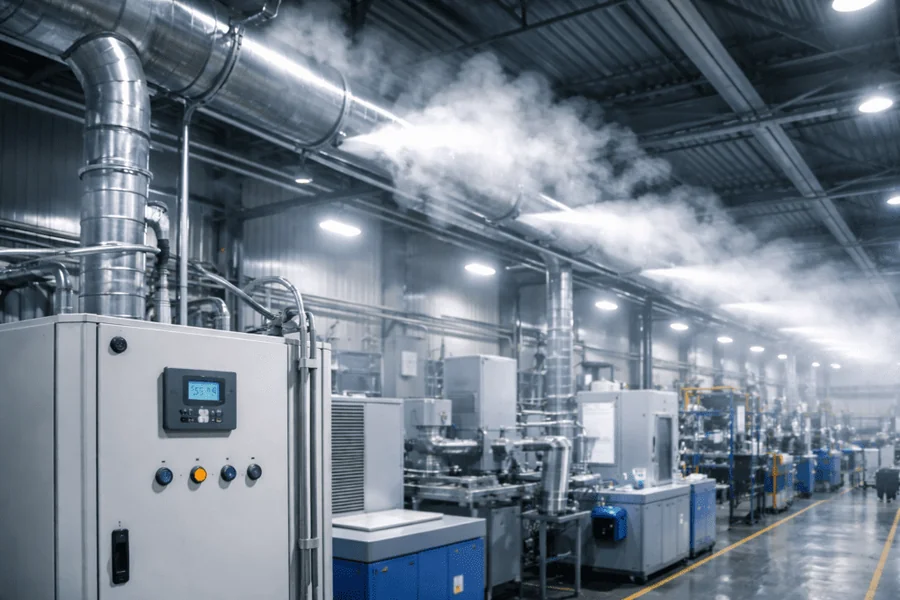
Humidity is one of the most overlooked variables in commercial and industrial facility management. While most operators focus on temperature control, ventilation, and energy costs, the moisture content of the air has an equally significant impact on employee health, product quality, equipment longevity, and operational efficiency. A commercial humidification system addresses that gap by maintaining precise relative humidity levels in large-scale environments, from manufacturing plants and warehouses to healthcare facilities and data centers.
This article examines what a commercial humidification system does, why standard HVAC systems fall short, and what to look for when selecting a system built for lasting results.
Key Takeaways
- A commercial humidification system maintains precise relative humidity levels that standard HVAC systems cannot deliver on their own.
- Dry air in commercial facilities leads to static electricity buildup, product degradation, and increased airborne pathogen activity.
- Automated controls and precision sensors eliminate the need for manual monitoring and maintain humidity within a 1 to 2 percent fluctuation range.
- Commercial humidification systems save between 50 and 90 percent more energy compared to traditional steam or ultrasonic humidification methods.
Why Humidity Control Matters In Commercial Environments
Most facility managers understand temperature and air quality management, but humidity often receives attention only after a problem has already developed. Low relative humidity creates a cascade of issues that affect both people and processes simultaneously.
The Consequences Of Dry Air
When relative humidity falls below 30 percent in a commercial setting, the effects are immediate and measurable. Static electricity begins to accumulate on surfaces and equipment, posing a risk to sensitive electronics and creating workplace hazards. Airborne particles, including dust, bacteria, and viruses, remain suspended longer in dry air, increasing the risk of respiratory illness among staff. Materials like paper, wood, and textiles lose moisture and become brittle, leading to increased waste and product defects.
The Consequences Of Excess Humidity
On the opposite end, uncontrolled high humidity creates condensation on surfaces and equipment, accelerating corrosion, promoting mold and mildew growth, and creating slippery floor conditions. The challenge for commercial facilities is not simply adding moisture to the air but maintaining it within a precise, stable range that serves both the environment and the process.
How Commercial Humidification Systems Work
Modern commercial humidification systems use one of several core technologies to introduce moisture into the air. The most advanced systems rely on adiabatic or evaporative processes that add humidity without raising the ambient temperature of the space.
Dry Fog Technology
Dry fog systems produce water droplets at approximately 4.2 microns in diameter, which is small enough that the droplets remain airborne and evaporate completely before reaching any surface. This non-wetting approach means that even at humidity levels above 90 percent, no moisture accumulates on floors, walls, machinery, or products. This is particularly important in environments where surface wetness would cause damage or safety concerns.
In-Duct Humidification
In-duct systems integrate directly into existing HVAC infrastructure, introducing humidity into the air stream before it is distributed throughout the facility. These systems are well-suited to large buildings with established air handling units and allow for uniform humidity distribution across multiple zones without requiring standalone units in each space.
Direct Space Humidification
Direct space systems are wall-mounted units that humidify a defined area without connecting to a duct system. They are highly practical for single rooms, targeted production areas, or facilities where duct integration is not feasible.
Key Benefits Of A Commercial Humidification System
| Benefit | Impact |
| Static electricity elimination | Protects electronics and reduces workplace hazards |
| Airborne pathogen reduction | Improves staff health and reduces sick days |
| Product quality preservation | Reduces waste and defects in moisture-sensitive materials |
| Equipment protection | Extends the lifespan of machinery and electronics |
| Energy efficiency | Reduces heating load through perceived warmth from moisture |
| Dust suppression | Improves air quality and reduces cleaning requirements |
What Separates A High-Performance System From A Basic One
Not all commercial humidification systems deliver the same level of precision or reliability. Several technical factors determine whether a system will perform consistently over its operational life.
Humidity Fluctuation Tolerance
Many humidification systems allow relative humidity to fluctuate by as much as 10 percent around the target level. High-performance systems reduce that range to 1 to 2 percent, which is critical in environments where even minor humidity shifts affect product quality or process outcomes.
Energy Consumption
Traditional steam humidification requires significant energy to heat water before it can be introduced into the air. Adiabatic systems that use cold water atomization bypass this energy cost entirely, using up to 90 percent less energy than steam-based alternatives. Over the operational life of the system, this difference represents substantial savings.
Maintenance Requirements
Systems with moving parts, pinhole nozzles, and complex water treatment needs require frequent servicing that adds to the total cost of ownership. Well-designed commercial systems use larger nozzle openings, no moving parts, and automated monitoring to reduce maintenance to periodic filter changes rather than regular technical callouts.
Automation And Integration
A commercial humidification system should integrate with existing building management and automated control systems. Real-time sensors that monitor and adjust humidity levels without operator intervention are essential for facilities that run continuous operations.
Industries That Rely On Commercial Humidification Systems
Commercial humidification is not industry-specific. It is a facility requirement that crosses sectors wherever environmental control is tied to output quality, safety, or compliance.
- Manufacturing facilities that process wood, paper, textiles, or electronics
- Food processing and storage operations managing perishable goods
- Healthcare facilities where infection control and patient comfort are priorities
- Data centers protecting sensitive server hardware from electrostatic discharge
- Cannabis cultivation operations requiring stage-specific humidity management
- Greenhouses and indoor grow facilities supporting year-round plant production
- Printing rooms where paper moisture content directly affects print registration
- Ripening rooms managing the post-harvest condition of produce
Conclusion
A well-chosen commercial humidification system does more than add moisture to the air. It protects equipment, preserves product quality, supports staff health, and reduces the energy and maintenance costs that come with poorly controlled indoor environments. As facility requirements grow more precise and compliance standards more demanding, the ability to maintain stable, verifiable humidity levels has become a fundamental part of responsible operations management.
Frequently Asked Questions
What relative humidity range should a commercial facility maintain?
Most commercial and industrial environments perform best between 40 and 60 percent relative humidity. The specific target depends on the industry and the processes or materials involved. Data centers and electronics facilities often target the lower end of this range, while food processing and grow operations may require levels above 70 percent for specific stages of their processes.
Can a commercial humidification system be retrofitted into an existing building?
Yes. Most modern commercial humidification systems are designed with retrofitting in mind. In-duct systems can integrate into existing air handling units, while direct space systems can be wall-mounted without any duct modification. Portable units offer additional flexibility for temporary or targeted humidification needs.
How often does a commercial humidification system require maintenance?
High-quality adiabatic and dry fog systems are designed with minimal maintenance requirements. Systems without moving parts and with larger nozzle openings typically need only periodic filter changes and an annual check of sensors and controls. Some systems require maintenance only once every two to three years.
Does a commercial humidification system increase energy costs?
Modern adiabatic systems are engineered to reduce overall energy consumption, not increase it. By adding humidity to the air, these systems create a perceived warming effect that allows facilities to lower thermostat settings without reducing comfort. The net result is often a reduction in overall facility energy costs.
What is the difference between a commercial and an industrial humidification system?
Commercial systems are typically designed for occupied spaces like offices, retail environments, and healthcare facilities where comfort and air quality are the primary goals. Industrial systems are built for the more demanding conditions of manufacturing, processing, and storage environments where precision, durability, and process compatibility are equally important.