
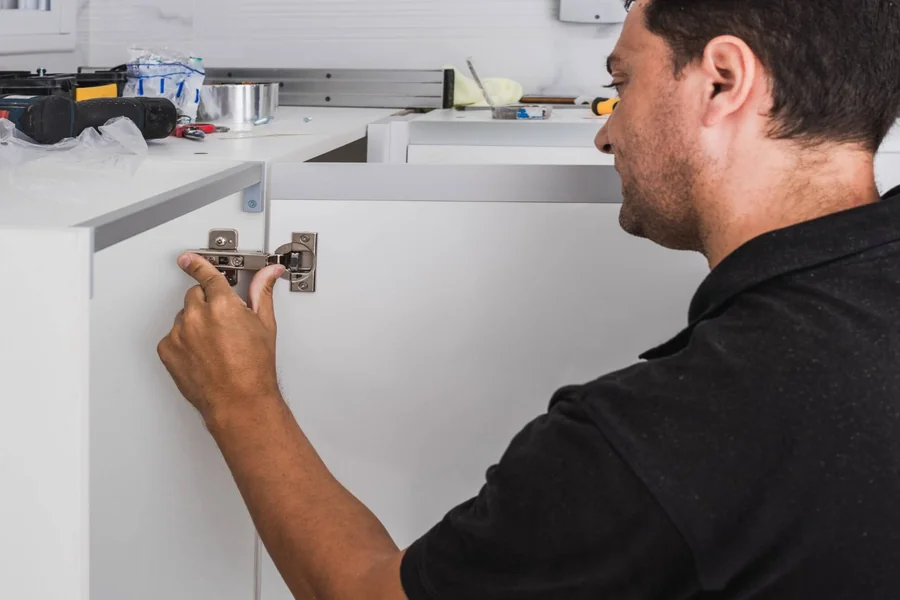
Cabinet hardware decisions rarely feel urgent until something goes wrong. A hinge that fails mid-project, ships inconsistently, or doesn’t perform as expected under daily use creates downstream problems that are difficult to correct once installation is complete. For cabinetmakers, millwork shops, kitchen and bath dealers, and commercial furniture manufacturers, the quality of a hinge supplier affects more than just the product itself. It affects timelines, warranty exposure, customer satisfaction, and the reputation of the finished work.
Soft close hinges in particular carry a higher performance expectation than standard hinges. They are specified because clients and end users expect smooth, controlled movement and long-term mechanical consistency. That expectation puts pressure on every part of the supply chain, starting with who makes the component. Choosing the right manufacturer is not simply a matter of finding the lowest price per unit. It requires evaluating whether a manufacturer can actually support your operation reliably over time.
This article outlines seven things worth examining closely before committing to a manufacturer relationship.
1. Manufacturing Origin and Production Transparency
When working with a soft close hinge manufacturer, one of the first things worth clarifying is where the products are actually made and how much visibility you have into that process. This matters because manufacturing origin directly affects lead times, quality control consistency, and your ability to resolve problems quickly when they arise.
Domestic manufacturers — those producing within the United States — operate under different logistical and compliance conditions than overseas suppliers. That difference has practical implications for how quickly you can reorder, how well you can communicate about custom requirements, and how reliably you can trace defects back to a production batch. A soft close hinge manufacturer based in the US typically offers shorter lead times, more direct communication channels, and greater accountability throughout the supply relationship.
Transparency about production processes — materials sourcing, assembly methods, quality inspection — is also a signal of organizational maturity. Manufacturers who can speak clearly about how they build their products are generally better positioned to support your business when specifications change or issues need to be addressed.
Why Country of Origin Affects More Than Shipping
Lead time is the most obvious advantage of domestic manufacturing, but it is not the only one. Regulatory compliance, material traceability, and labor standards all follow from where a product is made. For commercial or institutional projects, documentation of origin may also be required by contract or procurement policy. Understanding where your hardware comes from is increasingly relevant to how you manage supplier risk across the business.
2. Mechanical Consistency Across Production Runs
Soft close mechanisms depend on internal damping components that must perform within a narrow range of tension and resistance to feel right to the end user. If that performance varies from one production batch to the next, it creates an inconsistency problem that is nearly impossible to catch before installation and difficult to correct after the fact.
When evaluating a manufacturer, it is worth asking directly how they maintain consistency across production runs. Do they use standardized tooling? Is there a documented quality inspection process at the component level? What controls are in place to prevent variation in the damping mechanism itself?
The Practical Cost of Mechanical Variation
Inconsistent hinge performance creates a specific type of problem in finished cabinetry. If half the cabinets in a kitchen close at one speed and the other half close noticeably faster or slower, the perceived quality of the entire installation drops. That inconsistency is often attributed to the installer or the cabinetmaker, not the hardware supplier. The downstream reputational cost falls on the people who specified the product, not the manufacturer who shipped it. Choosing a manufacturer with strong quality control practices reduces that exposure significantly.
3. Product Range and Application Compatibility
A reliable manufacturing relationship works best when one supplier can support multiple cabinet configurations within a single project or across different project types. A manufacturer with a narrow product range forces you to source from multiple vendors, which adds complexity to purchasing, receiving, and warranty management.
Soft close hinges are used across a wide variety of door types — full overlay, half overlay, inset, and face frame configurations — and across door weights that vary considerably depending on materials. A manufacturer whose range covers these variations gives you more flexibility to specify from a single source rather than managing multiple supplier relationships for similar hardware categories.
Custom and Specialty Requirements
Some projects involve unusual door dimensions, non-standard opening angles, or materials that put unusual stress on the hinge mechanism. A manufacturer with engineering capability — even if basic — is better positioned to advise on compatibility or modify a standard product to fit a specific application. This is particularly relevant for commercial millwork, where specifications often deviate from residential norms and the cost of a wrong specification is considerably higher.
4. Load Ratings and Long-Term Durability Standards
Soft close hinges are mechanical components with a finite service life, and that service life varies considerably depending on how the product is engineered and what materials are used internally. Durability matters most in high-use environments — commercial kitchens, institutional furniture, multi-family residential — where cabinets may be opened and closed dozens of times per day over years of continuous use.
Manufacturers who test their products to recognized standards, such as those published by ASTM International, give you a documented basis for comparing durability claims across suppliers. Cycle testing in particular tells you how many open-close cycles a hinge is designed to withstand before mechanical failure, which is a meaningful number when specifying for long-term installations.
Why Durability Claims Require Verification
Many manufacturers publish durability claims without specifying the conditions under which those claims were tested. A cycle count measured under light load at room temperature tells you very little about how the hinge will perform in a humid environment under the weight of a solid wood door. When evaluating manufacturers, ask for test documentation rather than accepting published figures at face value. The willingness to provide that documentation is itself a useful indicator of how seriously a manufacturer treats product quality.
5. Minimum Order Flexibility and Inventory Availability
Supply chain disruptions over the past several years have made inventory availability a more pressing concern than it was previously. A manufacturer that carries consistent stock and can fulfill orders in reasonable quantities — without requiring large minimum orders that strain your purchasing budget — is a more practical long-term partner than one that operates on an extended lead time or requires bulk commitments.
This is especially important for smaller shops or mid-sized manufacturers who don’t have the storage capacity or cash flow to hold large quantities of hardware inventory. The ability to reorder in working quantities as projects come in, rather than in bulk months in advance, gives you more operational flexibility.
Backorder Patterns as a Reliability Signal
A manufacturer’s backorder history is something worth asking about directly. Frequent stockouts on core products suggest either insufficient production capacity or poor demand forecasting — both of which create problems for customers who depend on consistent availability. A supplier that backorients regularly forces you to either carry excess inventory yourself or accept project delays, neither of which is sustainable.
6. Technical Support and Application Guidance
Even experienced cabinetmakers and installers encounter situations where the right hinge selection isn’t immediately obvious. Door weight, frame thickness, overlay requirements, and finish compatibility can all create questions that require a knowledgeable response. A manufacturer with accessible technical support reduces the time you spend troubleshooting and the risk of a wrong specification reaching the job site.
Technical support quality also reflects how a manufacturer views its customer relationships. Suppliers who invest in making their products easy to specify correctly tend to be more reliable partners overall, because they understand that their reputation is tied to how well the product performs in real installations.
Documentation Quality as a Proxy for Technical Maturity
Installation guides, specification sheets, and compatibility charts are straightforward documents, but their quality varies significantly across manufacturers. Clear, accurate documentation reduces installation errors and shortens training time for new team members. If a manufacturer’s documentation is incomplete, ambiguous, or outdated, that is a signal about how the rest of the relationship is likely to be managed.
7. Warranty Terms and Accountability Processes
Warranty language is worth reading carefully before entering a supplier relationship, not because failures are expected, but because the terms of a warranty reflect how a manufacturer thinks about accountability. A warranty that covers manufacturing defects under normal use conditions and provides a clear process for resolution is a practical document. A warranty that contains broad exclusions, short coverage windows, or no clear resolution pathway is largely decorative.
For a soft close hinge manufacturer in the US, supporting a warranty claim should be logistically manageable — replacement product can ship domestically, communication is direct, and the resolution timeline is predictable. That operational reality makes warranty coverage more meaningful when it comes from a domestic supplier than from one where claims require international shipping and extended back-and-forth across time zones.
What Accountability Looks Like in Practice
Warranty accountability isn’t just about replacing defective units. It involves tracking patterns in product returns, communicating transparently about known issues, and updating production processes when problems recur. A manufacturer that treats warranty claims as data — rather than disputes to minimize — is one that uses that information to improve. That orientation toward quality improvement protects you as a long-term customer in ways that simply having a warranty document does not.
Making a Considered Decision
Selecting a hinge manufacturer is a supplier decision that will affect your work across many projects and often over many years. The factors outlined here are not exhaustive, but they represent the areas where the difference between a strong and a weak supplier relationship becomes most apparent over time.
Manufacturing transparency, mechanical consistency, product range, durability standards, inventory reliability, technical support, and warranty accountability each address a different dimension of operational risk. A manufacturer who performs well across most of these areas is likely to be a dependable partner. One who falls short in several of them will likely create recurring friction that is difficult to resolve without switching suppliers entirely.
The time spent evaluating these factors before committing to a supplier is considerably less than the time spent managing the consequences of a poor supplier choice on an active project. Approaching the decision methodically — rather than defaulting to price or availability alone — gives you a much stronger foundation for building a hardware supply relationship that holds up over time.