
In machining and precision manufacturing, tool life is not an abstract metric. It directly determines how many parts a shop can run before a changeover, how consistent dimensional tolerances remain across a production batch, and how predictably a cutting tool behaves under sustained thermal and mechanical stress. When a tool fails early or wears unevenly, the consequences extend well beyond replacing the insert — they affect cycle times, part quality, and operator confidence in the process.
Surface coatings have become one of the most reliable answers to this problem. Among them, titanium carbonitride has earned a strong reputation in production environments where standard tool materials fall short. Understanding what makes this coating work — not just in theory, but in the conditions machinists actually deal with — helps explain why it has become a default choice across so many cutting and forming applications.
What TiCN Coating Actually Is and How It Differs from Related Coatings
Titanium carbonitride is a compound formed by combining titanium, carbon, and nitrogen into a single ceramic-like structure. The resulting material, applied as a thin film to a tool or component surface, combines properties from two well-established coatings: titanium nitride (TiN) and titanium carbide (TiC). TiN offers good hardness and oxidation resistance. TiC offers higher hardness and better wear resistance. TiCN draws from both, producing a coating that outperforms each parent compound in demanding cutting conditions. Professionals evaluating surface treatment options can review how ticn coating is applied and specified through industrial coating providers to better understand the process requirements.
The chemistry behind this performance is not incidental. Carbon atoms incorporated into the titanium nitride lattice create a denser, harder microstructure. This structural density is what gives the coating its edge — it resists abrasive wear more effectively than TiN alone while maintaining enough toughness to avoid brittle fracture under intermittent cutting loads.
How the Coating Compares to TiN in Practical Use
Titanium nitride remains widely used because it is cost-effective and compatible with a broad range of substrate materials. It provides adequate protection in light-duty applications and is easy to identify by its characteristic gold color. However, TiN has a defined ceiling in terms of hardness and abrasion resistance. In applications involving harder workpiece materials, higher feed rates, or dry cutting conditions, TiN coatings wear through faster than many operations can tolerate.
TiCN closes this gap. Its hardness values sit meaningfully above TiN, which translates directly into longer tool life when cutting materials like stainless steel, hardened alloys, or cast iron. The tradeoff is that TiCN is typically applied at lower deposition temperatures than some other coatings, which actually makes it compatible with a wider range of substrate materials including high-speed steel — a substrate that cannot withstand the high temperatures required by certain other ceramic coatings.
The Role of Carbon in the Coating’s Microstructure
The carbon content in TiCN is not simply an additive. It modifies the fundamental crystal lattice of the titanium nitride structure in a way that reduces how easily the coating deforms or scratches under load. Carbon atoms occupy interstitial positions within the lattice, creating internal stresses that resist localized deformation. This is why TiCN performs better than TiN in abrasive wear scenarios — the coating does not yield as easily when hard particles from the workpiece material drag across the tool surface.
The proportion of carbon relative to nitrogen can also be adjusted during the deposition process to tune specific properties. Higher carbon content generally increases hardness but can reduce some toughness. This adjustability is one reason TiCN coatings are found across such a wide range of applications, from soft-material forming tools to aggressive metal-cutting operations.
The Physical Vapor Deposition Process and Why It Matters
TiCN coatings are most commonly applied through physical vapor deposition, a process in which a titanium source is vaporized in a vacuum chamber containing a reactive gas mixture of nitrogen and a carbon-bearing gas such as acetylene. The vaporized titanium reacts with these gases and deposits as a thin, adherent film on the tool surface. As described in detail through resources maintained by organizations like the National Institute of Standards and Technology, the physical and chemical properties of PVD coatings are directly influenced by the deposition parameters — chamber pressure, temperature, gas ratios, and ion bombardment energy all shape the final coating’s characteristics.
What distinguishes PVD from older chemical vapor deposition methods is the relatively low process temperature. CVD coatings require very high temperatures that can alter the temper of the substrate material, particularly in high-speed steel tools. PVD allows precise, well-adhered coatings to be applied at temperatures low enough to preserve the substrate’s mechanical properties. This distinction matters enormously in practice because a coating applied to a thermally compromised substrate is only as durable as the material beneath it.
Adhesion Quality and Its Effect on Tool Longevity
The adhesion between a coating and its substrate is the foundation of the coating’s effectiveness. A hard coating with poor adhesion will delaminate under cutting loads, often leaving the substrate in worse condition than an uncoated tool. For TiCN to perform as intended, the tool surface must be properly prepared before deposition — cleaned of oxides and contaminants, and sometimes given a surface activation treatment to improve bonding.
When adhesion is properly achieved, TiCN coatings behave as a functional part of the tool surface rather than a separate layer sitting on top of it. The coating moves with the substrate under stress rather than peeling away. This characteristic is what allows coated tools to maintain their geometry and edge sharpness through extended production runs where uncoated tools would have already experienced measurable wear.
Where TiCN Coating Performs Best
The applications best suited to TiCN are those where abrasive wear is the primary failure mechanism. This includes cutting operations involving abrasive workpiece materials — certain aluminum alloys with high silicon content, reinforced composites, hardened steels, and cast iron. In these contexts, the hardness of the coating directly prevents the rapid material loss that would otherwise occur at the tool’s cutting edge.
Beyond cutting tools, TiCN is applied to forming tools, punches, dies, and precision components where surface-to-surface contact creates wear over time. The coating reduces friction at the interface, which lowers heat generation and extends the service life of both the tool and, in some cases, the workpiece itself.
- Drilling and milling tools operating in abrasive alloy materials benefit from the coating’s resistance to edge rounding, preserving dimensional accuracy across long production runs.
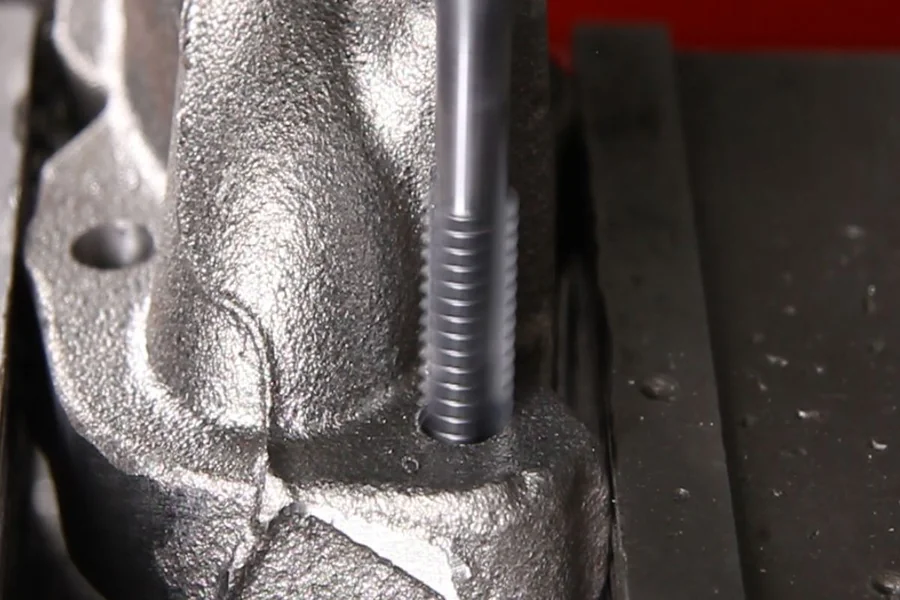
- Taps and threading tools, which experience significant flank wear in stainless steels, show notably extended life with TiCN due to the reduced friction and improved surface hardness.
- Stamping and punching dies experience reduced galling and pickup on the die face, especially when forming work-hardening materials.
- Precision shaft and bushing components in industrial equipment use TiCN to resist fretting wear in applications with cyclic contact loads.
- Medical device tooling relies on TiCN for its combination of hardness and relative biocompatibility compared to some other coating chemistries.
Limitations and Conditions Where TiCN Is Not the Optimal Choice
TiCN is a strong performer in mid-range cutting temperatures, but it has limits. At very high sustained temperatures — the kind encountered in aggressive dry cutting of titanium alloys or hardened steels at elevated speeds — the coating’s oxidation resistance falls below what some other coatings provide. TiAlN, for example, forms a protective alumina layer at high temperatures that TiCN does not replicate. In operations pushing the thermal limits of the cutting process, TiAlN or multilayer coatings may be more appropriate.
Similarly, in applications requiring maximum lubricity — such as deep-hole drilling where chip evacuation is difficult — the friction characteristics of TiCN, while better than uncoated tools, may not match the performance of DLC or other low-friction coatings specifically engineered for those conditions. Understanding where TiCN sits within the broader coating selection context prevents misapplication and the associated costs of premature tool failure.
How Machinists Evaluate Coating Performance in Production
The practical evaluation of a coating is not done in a laboratory. It happens on the shop floor, under production conditions, against real workpiece materials and real cycle times. Machinists assess coating performance through observable indicators: how long before the first signs of flank wear appear, whether the tool leaves consistent surface finishes across the full length of a run, and how predictably the tool behaves at end of life rather than failing suddenly or catastrophically.
TiCN consistently performs well against these measures in the applications it suits. The wear pattern tends to be gradual and predictable, which allows operators to establish reliable tool change intervals without excessive conservatism. This predictability reduces both the risk of unexpected tool failure and the cost of changing tools too early. Over a production year, the cumulative effect on tooling costs and throughput is significant — which is ultimately why shops that have adopted TiCN coatings in appropriate applications rarely return to uncoated or lesser-coated alternatives.
Closing Perspective
The durability of TiCN as a coating technology in precision manufacturing reflects something straightforward: it solves a real problem well. Abrasive wear is one of the most persistent causes of tool failure and inconsistency in machining, and TiCN addresses it at the most fundamental level — the surface chemistry and microstructure of the tool itself. The science behind titanium carbonitride is not complicated once explained in operational terms, and the results machinists observe align closely with what the material properties would predict.
For manufacturing engineers and tooling managers evaluating surface treatment options, the key is matching the coating to the wear mechanism. TiCN is not a universal solution, but in abrasive wear-dominated applications — particularly those involving mixed cutting conditions, high-speed steel substrates, or forming and stamping operations — it remains one of the most well-supported and consistently reliable options available. The accumulated field experience behind it, combined with a well-understood deposition process, makes it a low-risk choice for operations where tool performance directly affects production outcomes.