
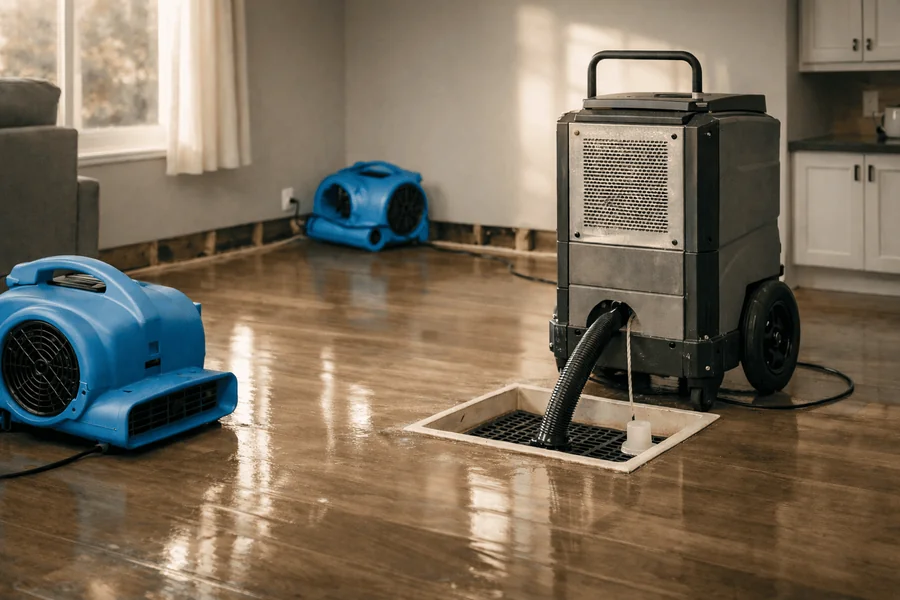
Floor air movers play a key role in rapid and efficient drying. They work even better when you combine them with heaters and dehumidifiers.
The combination produces an effective drying system that the professionals call the “triple threat” of the restoration. It encompasses the motion of air, heat, and moisture extraction. These tools minimize the drying time.
Here’s how floor air movers improve drying time with heaters or Dehumidifiers.
Understanding How Combined Drying Works
Every piece of drying equipment has a particular task. Air movers create high air velocity over wet surfaces. This airflow carries away moisture. It pushes the moisture into the air by rapid evaporation.
Dehumidifiers remove that water from the air. They pull in the damp air and condense it into water. This process makes the air dry and ready to absorb more wet surface moisture.
The heaters raise the air temperature. Warm air holds more moisture than cold air. This allows faster evaporation from wet materials. This permits quicker evaporation of damp stuff. When you combine heat with airflow and dehumidification, drying happens much faster.
These tools create a vicious drying process. Moisture is pushed to the air by air movers. Dehumidifiers remove the moisture. Heaters help speed up evaporation. This process goes on until the region is entirely dry.
Why Does This Combination Improve Efficiency?
Air movers in isolation are effective, but with dehumidifiers and heaters, the results can be improved. Efficiency and speed are enhanced by maintaining the proper ratio of the equipment.
The ratio of professionals traditionally is 4:1. This implies that three to five air movers are to be used for each industrial dehumidifier. This equilibrium maintains air flow and the elimination of moisture.
It is also necessary to control humidity. Experts suggest maintaining a relative humidity of 30-50%.
Dehumidifiers work best between 18°C and 32°C (65°F to 90°F). Heaters help maintain this ideal temperature range, especially in cooler environments.
Coverage is another key factor. A general rule is to use one air mover for every 50 to 70 square feet of wet floor space. This ensures even airflow across the entire area.
Real Benefits in Homes and Commercial Spaces
There are numerous benefits of this combined drying technique. It dramatically decreases the number of days to hours during drying. It inhibits mould and covers building materials. It also minimizes repair and downtimes.
Homeowners benefit from water leak repairs, carpet cleaning, or flood cleanup. The advantage is that the business is able to reopen at a quicker pace after water damage.
Example: Testing Temperature & Airflow Impact On Dehumidifier Performance
One field-related example of how temperature & airflow impact dehumidifier performance comes from controlled testing done by technicians at a building science lab in North Carolina.
Essentially, technicians were looking to see how much water could be removed from the air in a refrigerant dehumidifier when subjected to different temps & airflow conditions. Here are their results:
- Air Temp – 25°C or 77°F +/- Moderate Airflow – Dehumidifier removed approximately 100 Liters of water per day.
- Air Temp – 5°C or 41°F +/- Moderate Airflow – Dehumidifier could only remove approximately 60–70 Liters per day. (30-40% decrease in performance)
- Air Temp – 5°C or 41°F +/- Low Airflow (Fan on medium setting) – Coils were able to get colder which allowed for better moisture extraction. Proving that, in some cases, the speed of your airflow matters just as much as your temperature.
You can’t look at one without considering the other. Matching your ambient air temperature with the proper airflow velocity will allow your equipment to operate more efficiently (use less energy) while improving drying performance and decreasing operating costs.
Temperature & airflow don’t always go hand in hand when people think about drying or dehumidification. However, understanding how each functions and impacts overall equipment performance can help facility managers realize energy savings and improve moisture removal.
That’s why we created this handy chart. Download it, share it with your staff and start looking at temperature & airflow as two parts of a whole when it comes to drying. In most cases, they will both have a direct impact on your equipment’s ability to improve facility conditions.
Frequently Asked Questions (FAQ)
Can air temperature be too cold for a dehumidifier?
Yes, because refrigerant dehumidifiers rely on cool coil technology to condense moisture out of the air. If the surrounding air is too cold, there will not be enough moisture in the air for your dehumidifier to work properly.
What temperature is too cold for a dehumidifier?
In most cases, if your space dips below 15°C or 59°F your dehumidifier won’t work as well. Although there are desiccant dehumidifiers that can operate efficiently at colder temperatures.
Does a dehumidifier need lots of airflow?
Whether you’re dehumidifying or drying something, moisture will always try to reach equilibrium with its surrounding environment. If there’s too little airflow, the air immediately surrounding a wet surface will become saturated and will slow drying times.
Why is airflow important when dehumidifying?
If airflow is restricted or nonexistent, moisture has nowhere to go but back onto the surface you’re trying to dry. As air flows over a wet surface, moisture will begin to transfer to the air until the air is fully saturated.
Once saturated, that humid air needs to be replaced with drier air. Adequate airflow allows for constant replacement of that boundary layer air.
Does airflow matter in dehumidifiers?
Absolutely. If your dehumidifier doesn’t have enough airflow, it will struggle to remove moisture from the air. Dehumidifiers work by drawing moist air over a cold coil causing moisture to condense and collect inside the machine. Without proper airflow, this process doesn’t happen as efficiently.
How does airflow affect dehumidifiers?
Increases or decreases in airflow can impact your moisture remover device ability to remove moisture from the air. Both low airflow and high airflow can negatively impact dehumidifier performance.
How does temperature and airflow affect dehumidifiers?
Temperatures affect the air’s ability to hold moisture. The higher the temperature, the more moisture the air can hold. That’s why dehumidifiers have a harder time collecting moisture from air as the temperature decreases.
Warmer air also allows the moisture to evaporate quicker, speeding up the drying process.
Conclusion
Floor air movers provide better performance with heaters or dehumidifiers. The evaporation is enhanced by air movers. The moisture in the air is removed by dehumidifiers. And the whole process is accelerated by heaters. The combination of them forms a fast, efficient, and reliable drying system. Make sure to place the air movers in a circular pattern. Position air movers at a 45-degree angle toward walls or wet surfaces.