
A setter once worked with whatever the eye could resolve on its own. A watchmaker’s loupe clipped to the brow added a few diameters, and that was the entire optical apparatus behind some of the most admired jewels in European collections. The limit was real, and it sat on the work rather than on the worker.
Stereo magnification at the bench, the rise of micro pavé, and what gemstone work for high jewelry now asks of the hand
That limit decided things nobody ever wrote down as a rule. A stone below a certain size could not be seated reliably, because the seat itself could not be seen well enough to judge. Rows of small brilliants could be set close together, but never as close as a drawing might suggest. Designers learned where the boundary lay and drew inside it.
Stereo microscopes arrived at the setting bench from laboratories and from surgery. The boundary moved, and it has kept moving since. The drawings have caught up with the optics.
What the loupe could not show
A loupe gives magnification and takes away almost everything else. It fixes the working distance, it commits one eye, and it offers no depth. Depth is the part that matters. A graver cuts a seat at an angle, inside a metal wall barely thicker than the girdle of the stone it will hold. Under a loupe, much of that has to be inferred rather than seen.
Setters compensated with feel. Decades of it went into knowing when a bearing was deep enough, judged from the sound of the burin and the drag on the wrist. Careers in Paris, Geneva and Valenza were built on exactly that. What the hand could not do was verify.
The stone setting bench after the microscope arrived
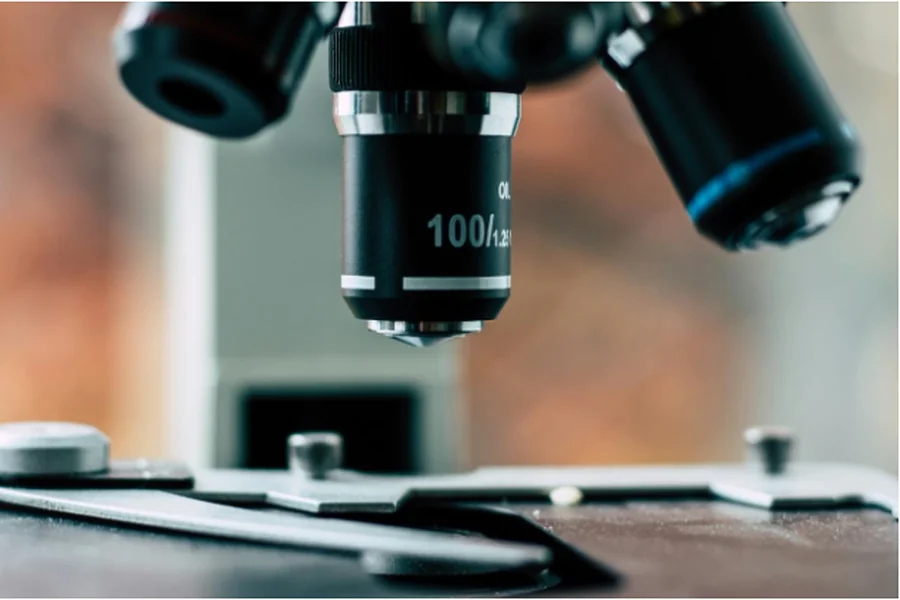
A bench equipped for magnified work is laid out differently. The stereo microscope sits on a boom arm over the pin, and the piece rises to meet the optics. A pneumatic handpiece drives the graver at a stroke rate no wrist can hold, and the precision expected in high jewelry tightened accordingly. Benches like this are standard in the ateliers that cut micro pavé, and in the schools that teach stone setting on its own terms, Rome’s Gerardi Setting School among them. One of the few institutions in Europe given over entirely to setting, it works with trinocular microscopes at every bench and treats the Gravermax as ordinary equipment.
The change was not only optical. Under twenty or thirty diameters the setter watches the seat, the bearing and the tip actually forming. A bright cut that looked clean to the naked eye shows its ragged edge.
That visibility runs both ways. Faults a client would never have noticed became unmissable to the person committing them, and ateliers began asking for finishes that nobody had needed to ask for before.
What magnification does to the posture and to the hand
Jewelry has produced very little formal research on any of this, but adjacent precision trades have. Dentistry took up loupes and operating microscopes on a far larger scale, and studied what followed. A 2024 systematic review in the Journal of Clinical and Experimental Dentistry pooled eleven laboratory studies and found that magnification significantly improves posture and lowers the risk of musculoskeletal disorders.
The same review found no statistically significant gain in the quality of the work itself. Its authors point to the fact that the studies used students rather than experienced practitioners, and they treat the learning curve as the likely explanation. Operators reported difficulty adapting to the instrument. Two of the eleven studies found that magnification sped the workflow up.
The settings that exist only because of magnification
Micro pavé is the clearest case. Stones under a millimeter across, held in rows by beads raised from the metal between them, need a seat cut to a tolerance the unaided eye cannot judge at all.
Other work changed by degrees rather than in kind. Bezel and griffe settings were being made competently long before the microscope arrived, and they still are. What magnification altered there was the finish: the evenness of a burnished bezel edge, the symmetry of four prongs seen at thirty times life size. Invisible settings and dense channel work sit somewhere between the two, close to impossible before and merely demanding now.
None of this was announced, and workshops took up the equipment one bench at a time. The catalog of what a house could offer widened quietly, with no single moment when the trade agreed its rules had changed. Buyers noticed only the result.
Why better sight did not make the work any easier
A setter starting today learns two things at once, the craft and the instrument, and the second is not free. Posture under a boom arm has to be built deliberately. The hands work in a field they cannot feel their way around, and the first months at magnification run slower than the last months without it. Instructors describe an adaptation period before the advantage appears at all. Nothing about the microscope shortens the years that mastery of setting takes.
What the instrument did was raise the ceiling and, with it, the floor. Pieces that would have counted as exceptional in 1960 are routine commissions now, and the client who orders one has no particular reason to know why. The eye got help. The hand never did.