
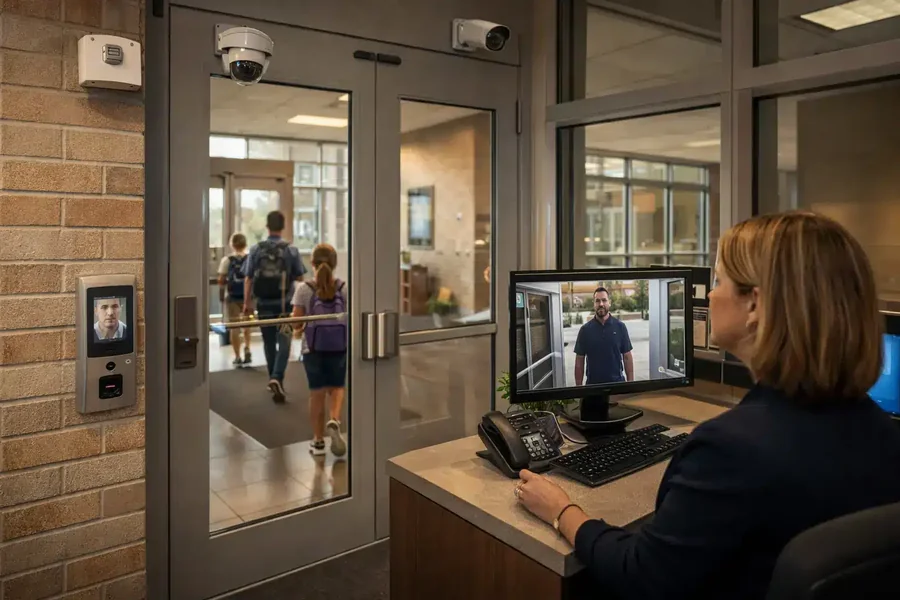
School administrators and facilities directors across the United States are under growing pressure to make access management decisions that serve multiple, sometimes competing, demands. They need systems that keep students and staff safe, work consistently without manual intervention, and hold up under the practical weight of daily school operations. Traditional key-based or card-based entry systems have served institutions for decades, but they carry well-documented weaknesses — lost credentials, shared access, and the difficulty of auditing who entered a building and when.
Biometric access systems address some of these weaknesses directly. But purchasing one without a clear understanding of how they actually function in educational environments, what operational trade-offs exist, and what questions to ask before signing a contract leads to costly regret. This guide is written for those responsible for making that decision — facilities managers, district technology coordinators, school security officers, and administrators — who need a clear, grounded framework rather than a sales pitch.
What Biometric Access Control for Education Actually Involves
Biometric access control for education refers to identity verification systems that use physical or behavioral characteristics — most commonly fingerprints, hand geometry, iris patterns, or facial recognition — to grant or deny entry to school buildings, rooms, or zones. Unlike a key or access card, a biometric identifier belongs to the person. It cannot be borrowed, shared, or easily duplicated. When properly deployed, these systems create a direct link between a physical identity and a permission set stored in the access management platform.
For schools specifically, this has meaningful operational implications. A student cannot hand their ID badge to a friend. A contractor cannot use a copied key to re-enter a building after their authorization has expired. A staff member who has been terminated no longer has any physical credential to recover or deactivate — their access is revoked at the system level, and nothing they carry has any further function.
Those evaluating options can review how institutions are structuring these deployments by examining services built around biometric access control for education, which illustrate how technology providers are approaching enrollment, management, and integration in school-specific contexts.
The Difference Between Identification and Verification
One distinction that matters before purchasing is the difference between identification and verification. Verification systems ask: “Is this person who they claim to be?” The user presents a biometric along with another credential — a PIN, a card, or an ID number — and the system checks that the biometric matches the stored template for that specific identity. Identification systems ask: “Who is this person?” The biometric alone is compared against the entire enrolled database to find a match.
In educational settings, verification is the more common approach. It is faster, generally more accurate under real-world conditions, and places less processing demand on the system when enrollment counts are high. Identification systems are better suited to controlled environments with smaller user populations, or in scenarios where time-sensitive screening must occur without any prior credential presentation.
Why Educational Environments Present Unique Access Management Challenges
Schools are not office buildings. The access management demands of an educational environment are shaped by a population that is constantly changing, a schedule that is predictable in structure but variable in practice, and a regulatory environment that imposes specific obligations on how student data is handled. These factors collectively mean that a system designed for a corporate headquarters will not simply transfer to a school campus without meaningful adjustment.
Student populations turn over annually. Staff rosters change with hiring cycles. Contractors, volunteers, and visitors move through buildings on irregular schedules. Any access system must accommodate not just daily authentication but also ongoing enrollment, de-enrollment, and permission adjustments at a scale that most commercial buildings rarely encounter.
The Enrollment and De-Enrollment Burden
One of the most underestimated operational costs in biometric access deployment is the ongoing management of the enrolled user database. At the start of each academic year, new students and staff must be enrolled. At the end of the year, or when individuals leave mid-year, records must be properly closed out. In districts with high staff turnover or large student bodies, this is not a minor administrative task — it is a sustained process that requires clear ownership and procedure.
Systems that make enrollment and de-enrollment simple and auditable reduce this burden significantly. Systems that require technical staff to manage every change, or that lack clear reporting on who is currently enrolled and what their access permissions include, create gaps that accumulate over time. Before committing to a platform, administrators should request a walkthrough of the enrollment workflow, understand who manages it day-to-day, and confirm what happens to biometric data when a user is removed.
Visitor and Contractor Access Management
Permanent staff and students represent the consistent population, but schools regularly admit a significant volume of temporary visitors — delivery personnel, maintenance contractors, substitute teachers, and parents. Biometric systems designed only for permanent users may create friction or blind spots when these individuals need access. Some platforms extend visitor management through temporary credential issuance, time-limited permissions, or companion systems that do not require biometric enrollment for short-term visitors.
The risk of not addressing visitor access properly is straightforward: a school that secures its main entry with a biometric system but has no coherent process for temporary visitors has not secured its entry — it has redirected uncontrolled access through a different path.
Legal and Privacy Considerations Specific to US Schools
In the United States, the collection and storage of biometric data from minors is subject to a range of state and federal requirements. The Family Educational Rights and Privacy Act governs the protection of student records broadly, but several states have enacted biometric privacy laws that impose specific consent, storage, and deletion obligations. Illinois, Texas, and Washington are among the states with dedicated biometric privacy statutes, and schools operating in those jurisdictions face enforceable compliance requirements — not just best-practice guidelines.
Federal guidelines on student privacy, including those published by the Student Privacy Policy Office within the U.S. Department of Education, offer schools a framework for evaluating how technology deployments interact with existing legal obligations. Administrators should consult these resources before finalizing vendor contracts.
What to Ask Vendors About Data Handling
Technology vendors often describe their biometric data practices in general terms during sales conversations. For educational purchasers, general assurances are not sufficient. The questions that matter are specific: Where is biometric data stored — on-premise, in the cloud, or both? Who has access to that data and under what conditions? How is data deleted when a student graduates or transfers? Can the institution retrieve and audit its own data independently, without vendor involvement?
A vendor that cannot answer these questions clearly, or that deflects to contract language rather than technical explanation, is a vendor whose data practices have not been built with school compliance requirements in mind. That gap will surface eventually — ideally before, rather than after, deployment.
Technology Types and Their Practical Trade-Offs
The biometric modalities most relevant to school access control each carry operational characteristics that affect reliability, speed, and user acceptance. Fingerprint readers are the most widely deployed and generally the most cost-effective, but they can struggle with consistency in users whose fingerprints are faint, worn, or affected by environmental conditions. Facial recognition systems offer contactless authentication, which has practical advantages in high-traffic entry points, but require adequate lighting and positioning infrastructure to perform reliably.
Iris recognition offers strong accuracy in controlled conditions but requires users to interact with the reader in a deliberate way that may not suit high-volume entry flows. Hand geometry readers are durable and accurate but physically larger, which affects installation options. No single modality is ideal for every school environment — the right choice depends on the specific entry points being secured, the volume and composition of users, and the environmental conditions at each location.
Integration with Existing Systems
A biometric access system does not operate in isolation. It needs to work with the existing physical infrastructure — door hardware, locking mechanisms, alarm panels — as well as with software platforms used for visitor management, identity management, and potentially student information systems. A system that handles biometric authentication well but integrates poorly with existing infrastructure creates an island of functionality rather than a coherent security layer.
Before purchasing, facilities managers should document every existing system that the new platform will need to connect to and ask vendors to demonstrate — not just describe — how that integration works. Reviewing case studies from other K-12 deployments, particularly in districts of similar size and infrastructure complexity, provides more reliable insight than vendor-supplied feature comparisons.
Building an Internal Readiness Assessment Before Purchasing
The decision to adopt biometric access control for education is as much an operational decision as a technology decision. Schools that invest in the right system but lack the internal processes to manage it consistently will not achieve the security outcomes they are seeking. Before issuing an RFP or beginning vendor conversations, it is worth conducting an honest internal assessment of readiness.
This means understanding who will own the system once deployed — not just during implementation, but on an ongoing basis. It means confirming that the facilities team or IT department has the capacity to manage user enrollment at scale. It means establishing how access permission changes will be requested, approved, and executed, and what the process is when something goes wrong.
Phased Deployment as a Risk Management Strategy
Large-scale deployments that cover every entry point of a multi-building campus from day one introduce compounding risk. If the system encounters enrollment problems, integration failures, or user adoption resistance, those issues affect the entire campus simultaneously. A phased approach — beginning with one or two high-priority entry points, establishing operational confidence, and expanding from there — allows institutions to identify problems in a contained context before they affect the full deployment.
Phased deployment also provides real-world data to inform subsequent phases. Enrollment times, failure rates, user complaints, and maintenance demands all become measurable, and those measurements support better decisions about how to proceed than any vendor-supplied projection.
Closing Considerations for US School Decision-Makers
Investing in biometric access control for education is a decision that will shape how a school manages physical security for years. The technology, when properly selected and deployed, addresses real vulnerabilities in traditional access management. It provides an auditable record of building entry, removes the credential-sharing problem that undermines card-based systems, and supports the kind of consistent, reliable access management that school safety demands.
But the technology is only one part of the outcome. The vendor relationship, the data handling practices, the integration with existing systems, and the internal processes that support day-to-day management are equally determinative. Schools that approach this purchase as a technology procurement alone will miss the operational factors that determine whether a deployment actually performs as intended.
The framework in this guide is designed to give decision-makers the right questions before they begin vendor conversations — not to make the decision for them, but to ensure that the decision gets made on the basis of operational reality rather than sales positioning. That distinction, in a procurement of this kind, matters considerably.