
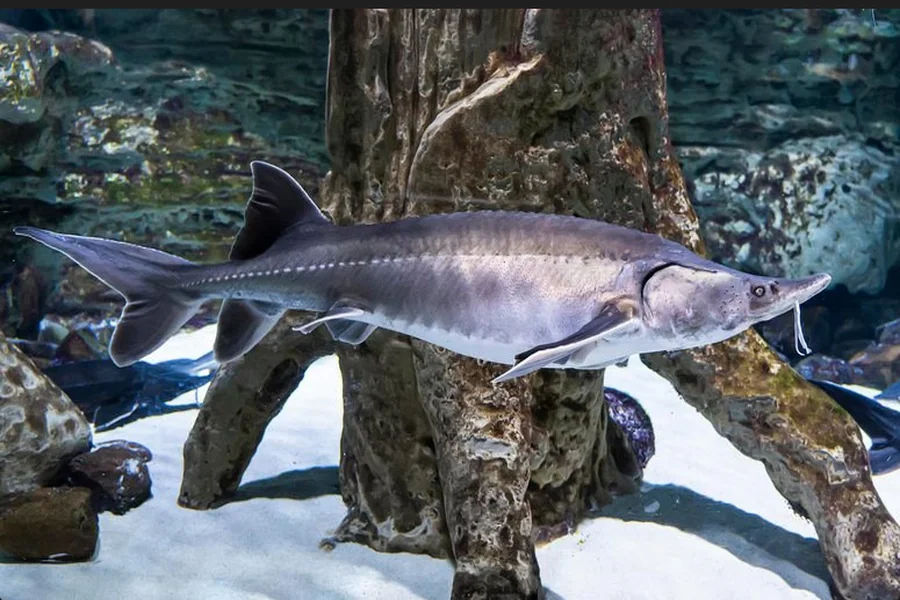
Few ingredients carry the weight of history that russian sturgeon caviar does. Long before Michelin stars existed, before “fine dining” was even a concept, sturgeon were already feeding emperors, fueling trade routes, and quietly becoming one of the most coveted ingredients on earth. This is the story of a fish that’s been around longer than most species alive today — and somehow ended up at the center of the world’s most elegant tables.
A Living Fossil: The Natural History of Sturgeon
Sturgeon are genuinely ancient. Not “this brand has been around since 1987” ancient — we’re talking 200 million years. They were here before the dinosaurs disappeared, and they’ve changed remarkably little since. Scientists sometimes call them living fossils, not as a poetic flourish, but because the fossil record and modern sturgeon look nearly identical.
There are around 27 known species. Some are small. Others — like the beluga — can reach five meters and weigh over a ton. They have no true bones, just cartilage. Their bodies are lined with bony plates called scutes instead of scales. They look prehistoric because they are.
What’s remarkable is how little pressure they felt to evolve. Their design worked. The deep rivers and cold seas they inhabited were stable enough that there was no particular reason to change. That stability, ironically, is part of what makes them so vulnerable now — they never developed the adaptability that faster-cycling species take for granted.
Habitat and Migration: Where Sturgeon Roam
Sturgeon are anadromous, meaning they live in saltwater but return to freshwater rivers to spawn — the same basic pattern as salmon, though on a very different timescale. Some sturgeon don’t reach sexual maturity until they’re 20 years old. A beluga might live to 100.
Their historic range was enormous. The Caspian Sea — shared by Russia, Iran, Azerbaijan, Kazakhstan, and Turkmenistan — was the global center of sturgeon populations for centuries. The Volga River, feeding into the Caspian from the north, was the single most important spawning ground on earth. Beyond the Caspian, sturgeon ranged across the Black Sea, the Adriatic, major European rivers like the Rhine and Danube, and North American waterways from the Gulf of Mexico up through the Great Lakes.
That range has contracted dramatically. Dams block migration routes. Pollution degrades spawning habitat. Poaching pressure, especially through the 20th century, hit wild populations hard. Most wild sturgeon fisheries are now closed or heavily restricted.
Caviar in Russian Imperial Culture
Russia’s relationship with sturgeon goes back at least a thousand years. By the time of the tsars, sturgeon fishing on the Volga was a serious state enterprise — not a cottage industry, but an organized system with designated fishing grounds, quotas, and direct links to the imperial court.
Caviar at this level wasn’t a luxury in the modern sense. It was closer to a political currency. The tsar’s table featured it as a matter of course. Monasteries along the Volga received sturgeon as religious tribute. Foreign dignitaries left Russia having tasted something they couldn’t find anywhere else — and went home wanting more.
The Russian Orthodox Church played an unexpected role in spreading caviar culture. Because caviar was classified as fish rather than meat, it was permitted during fasting periods. This made it a staple of religious observance for the upper classes, appearing on tables throughout Lent when meat was forbidden. That combination — imperial prestige and religious permission — gave caviar a cultural foothold that no marketing campaign could have manufactured.
How Russian Sturgeon Caviar Conquered the World’s Tables
The export of Russian sturgeon caviar to Western Europe began in earnest in the 19th century, accelerating after refrigeration made long-distance transport viable. Paris got there first. French haute cuisine absorbed caviar into its vocabulary quickly, serving it as a first course with blinis and crème fraîche in a presentation that became the global template.
By the early 20th century, caviar had crossed the Atlantic. American sturgeon — particularly from the Hudson River and Chesapeake Bay — had briefly supplied a domestic market, but overfishing collapsed those populations by the 1900s. That left the Caspian as the dominant source, and Russian and Iranian producers as the world’s primary suppliers.
The post-war decades cemented caviar’s status as the shorthand for luxury. It appeared at diplomatic dinners, in James Bond films, in the pages of every aspirational food magazine. The association was so strong that “caviar taste on a beer budget” became a fixed idiom in English — a phrase that only works if everyone already knows caviar sits at the top of the hierarchy.
Modern Aquaculture and Sustainability
Wild Caspian stocks collapsed through the 1990s and 2000s. The Soviet Union had maintained some controls on fishing; when it dissolved, those controls largely evaporated. Poaching surged. By the mid-2000s, the Convention on International Trade in Endangered Species had suspended most wild caviar exports from Caspian nations.
Aquaculture filled the gap — and faster than most people expected. Sturgeon farming had been attempted for decades with mixed results, but producers in Italy, France, China, Uruguay, and the United States eventually worked out the husbandry. The core challenge is time: you can’t rush a sturgeon. A female Russian sturgeon raised in a farm still takes 8 to 12 years to produce eggs. That’s an enormous capital commitment before a single tin goes to market.
The caviar available today is almost entirely farmed. Quality has improved substantially — early farmed caviar had a reputation for inconsistency, but modern producers have refined their feeding, water quality, and harvesting techniques to a point where the best farmed Russian sturgeon caviar is genuinely excellent. The environmental picture is also better: responsible farms operate closed water systems, don’t deplete wild populations, and in some cases actively participate in restocking programs.
Final Thoughts
Sturgeon survived the Cretaceous extinction. They outlasted empires, fed tsars, and crossed oceans in refrigerated holds to reach tables in Paris and New York. The fact that they’re still here — farmed rather than wild, protected rather than plundered — is, depending on how you look at it, either a conservation success story or a very close call.
What hasn’t changed is the product itself. The flavour profile of good Russian sturgeon caviar is the same as it was at the imperial court: clean, oceanic, with that particular richness that comes from the fat content of the eggs. If you want to understand why this ingredient survived everything history threw at it, the simplest answer is just to taste it. You can buy black caviar and experience it for yourself — no diplomatic dinner required.